

TL;DR:
- Marble in South Florida deteriorates quickly due to humidity, salt air, and sand tracked in.
- Professional restoration involves assessment, deep cleaning, honing, polishing, and sealing for best results.
- Ongoing proper maintenance and local expertise are key to long-lasting marble floors.
You’ve mopped, you’ve scrubbed, and you’ve done everything right, yet your marble floors still look dull, scratched, or stained. That’s one of the most common frustrations we hear from South Florida homeowners. The truth is, routine cleaning can only do so much. Marble is a porous, reactive stone, and in a climate like South Florida’s, with its relentless humidity, salt air, and fine sand tracked in from the beach, the surface degrades faster than most people expect. This guide walks you through the full restoration process, from understanding what’s actually happening to your floors to keeping them looking polished for years after treatment.
Table of Contents
- Understanding marble floor damage and restoration basics
- Essential tools, materials, and professional expertise required
- Step-by-step process to restore marble floors
- Troubleshooting, mistakes to avoid, and expert solutions
- Maintaining restored marble: post-restoration care for lasting shine
- Why local expertise and preventive care matter most
- Restore your marble floors — contact experts for a free evaluation
- Frequently asked questions
Key Takeaways
| Point | Details |
|---|---|
| Restoration over replacement | Restoring marble floors costs far less and brings the original shine back without a complete replacement. |
| Climate-specific care | South Florida’s humidity and sandy environment demand specialized materials and frequent sealing. |
| Professional methods recommended | Expert tools and processes prevent damage and achieve a long-lasting, even finish. |
| Routine maintenance essential | Post-restoration care like pH-neutral cleaning and regular resealing extends marble life for years. |
Understanding marble floor damage and restoration basics
Before you can fix a marble floor, you need to know what you’re dealing with. Not all damage looks the same, and treating the wrong problem with the wrong method can make things worse.
The three most common types of damage are:
- Etching: Dull, whitish marks caused by acidic substances like citrus juice, wine, or even certain cleaning products reacting with the calcium carbonate in marble.
- Staining: Discoloration caused by oils, rust, or organic matter soaking into the porous stone.
- Scratching: Surface abrasion from sand, grit, or hard-soled shoes that cuts into the finish.
South Florida’s environment accelerates all three. Marble can develop etch marks, scratches, and stains, especially in humid, sandy environments like South Florida, where moisture opens the stone’s pores and fine particles act like sandpaper underfoot. Salt air near the coast adds another layer of chemical stress that you simply won’t find in drier climates.
The good news is that restoration is almost always the smarter financial choice. Restoration costs $4 to $18 per square foot and is 80 to 90% cheaper than full replacement. That’s a significant difference when you’re dealing with hundreds of square feet of flooring.
Here’s a quick look at how restoration stacks up against replacement:
| Factor | Restoration | Replacement |
|---|---|---|
| Cost per sq ft | $4 to $18 | $20 to $100+ |
| Timeline | 1 to 3 days | 1 to 2 weeks |
| Disruption | Minimal | Major |
| Preserves original stone | Yes | No |
| Eco-friendly | Yes | No |
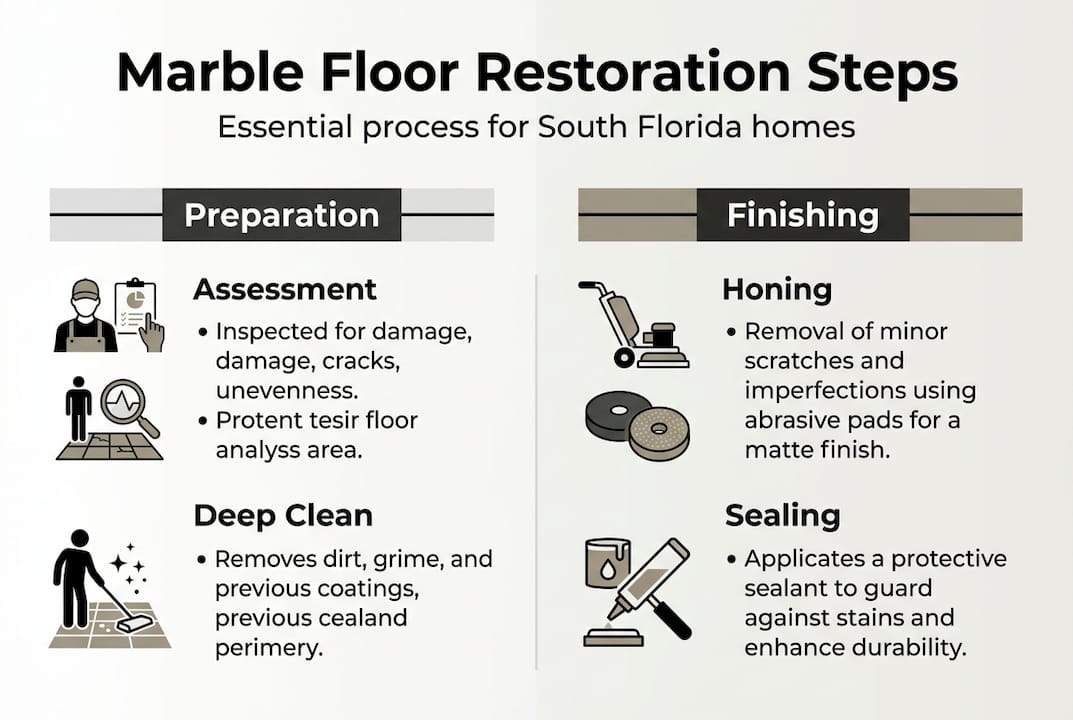
The basic restoration process moves through five stages: assessment, deep cleaning, honing (removing surface damage with abrasives), polishing (restoring shine), and sealing (protecting the surface). For long-term marble care, understanding each stage helps you make better decisions about timing and professional involvement. Even the U.S. General Services Administration recommends a structured, multi-step approach when cleaning historic marble to avoid permanent surface loss.
Essential tools, materials, and professional expertise required
Knowing what goes into a proper restoration helps you understand why results vary so dramatically between a professional job and a DIY attempt.
Professional restorers rely on a specific set of tools:
- Inspection lights: Raking light tools that reveal scratches and etch patterns invisible under normal lighting.
- Diamond abrasive pads: Ranging from 50 to 3000 grit, used in sequence to grind down damage and build up polish.
- Polishing powders: Compound formulas matched to the specific marble type and finish desired.
- High-quality penetrating sealers: Applied after polishing to block moisture and staining agents.
- pH-neutral cleaners: The only safe cleaning agents for marble at any stage.
Professionals use multi-step diamond abrasive pads, polishing powders, and high-quality sealers tailored for local conditions. That last part matters more than most people realize. A sealer that performs well in a dry Arizona climate may not hold up in Boca Raton’s humidity.
Here’s how professional and DIY approaches compare honestly:
| Criteria | Professional | DIY |
|---|---|---|
| Equipment quality | Industrial grade | Consumer grade |
| Grit sequencing | Precise, multi-stage | Often skipped |
| Risk of damage | Low | Moderate to high |
| Finish quality | Mirror or satin | Inconsistent |
| Local knowledge | Yes | Rarely |
For marble care in humidity, local expertise isn’t just a bonus, it’s a real differentiator. A specialist who works in South Florida every day knows how salt air affects sealer adhesion and how fast moisture re-enters freshly honed stone.
When it comes to restoring etched marble, the process requires mechanical abrasion, not just cleaning, which is why consumer products rarely solve the problem.
Pro Tip: Always test any new cleaning solution on a small, hidden area of your marble first. Even products labeled “stone safe” can react differently depending on the marble variety and finish.
Step-by-step process to restore marble floors
Here’s what a professional marble floor restoration actually looks like from start to finish.
- Assessment: A trained technician inspects the floor under raking light to map all etch marks, scratches, stains, and lippage (uneven tile edges). This determines which grit sequence and techniques are needed.
- Deep cleaning: The floor is cleaned with a pH-neutral solution to remove surface dirt, wax buildup, and residue. This step ensures abrasives work on the stone itself, not on contamination.
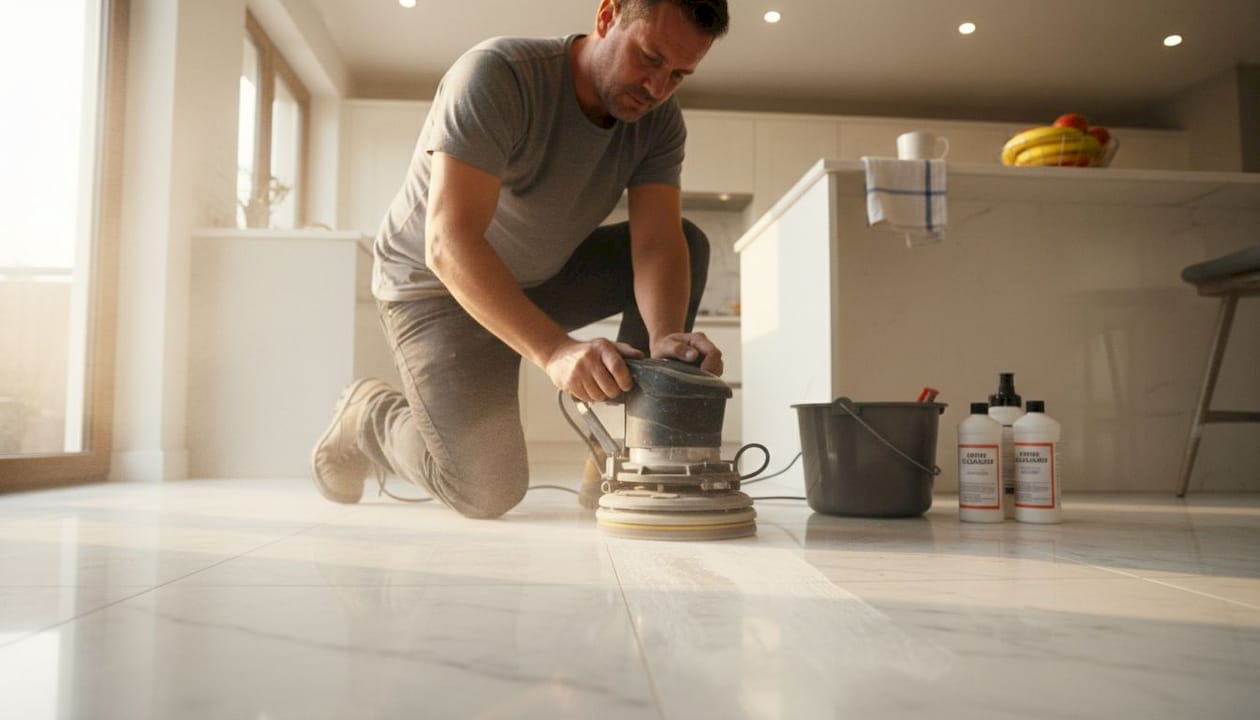
- Honing: Diamond pads starting at a coarser grit (often 100 to 400) grind away scratches and etch marks. Technicians work through progressively finer grits until the surface is smooth and uniform.
- Polishing: Fine diamond pads (1500 to 3000 grit) combined with polishing powder bring the surface to the desired finish, from a soft hone to a high mirror gloss.
- Sealing: A penetrating sealer is applied to protect the restored surface from moisture, staining, and abrasion.
The standard process includes inspection, deep cleaning, honing, multi-stage polishing, and sealing, and for most residential floors, the full job takes one to three days.
“The difference between a good restoration and a great one is almost always in the honing stage. Rushing through grit sequences leaves micro-scratches that show up later as a hazy finish.”
For residential marble restoration in South Florida, the honing stage also addresses efflorescence, which is a white, powdery mineral deposit that forms when moisture moves through the stone and deposits salts on the surface. It’s more common here than in most other regions.
Pro Tip: Seal the floor immediately after polishing, ideally within the same session. Waiting even 24 hours in South Florida’s humidity allows moisture to re-enter the stone and reduces how well the sealer bonds.
Troubleshooting, mistakes to avoid, and expert solutions
Even with the best intentions, homeowners make mistakes that turn a manageable problem into a costly one. Here are the most common ones we see.
Using acidic or abrasive cleaners: Vinegar, bleach, and grout cleaners are marble’s worst enemies. They etch the surface on contact. Even “natural” cleaners like lemon juice cause immediate damage.
Skipping the sealer: Polishing without sealing is like painting a wall without primer. The finish looks great for a few weeks, then fades fast.
Overwetting the floor: Excess water pushes into the stone and causes staining, efflorescence, and in severe cases, tile lifting.
For marble floor cleaning between professional visits, use a barely damp mop and dry the surface immediately.
Acid etching is not a stain and requires mechanical honing, not just cleaning. This is one of the most misunderstood facts in marble care. Homeowners often apply more cleaner to an etch mark, which makes it worse.
“If you can feel the dull spot with your fingertip, it’s an etch. No cleaner will fix it. Only abrasion restores the surface.”
For deep stains, a poultice left for 8 to 24 hours, then carefully rinsed and scraped, draws the staining agent out of the stone. Poultices are made from absorbent powder mixed with a chemical agent matched to the stain type. Rust stains need a different formula than oil stains.
South Florida’s salt air and humidity accelerate all of these issues. Salt deposits can cause surface pitting over time, and high moisture levels mean stains penetrate faster and deeper. Following solid marble maintenance tips between professional visits makes a measurable difference in how long your results last.
Maintaining restored marble: post-restoration care for lasting shine
Restoration is an investment. How you care for the floor afterward determines whether that investment lasts two years or ten.
Here’s the routine we recommend for South Florida homes:
- Daily: Dry dust mop to remove sand and grit before they scratch the surface. This single habit prevents more damage than any product.
- Weekly: Mop with a pH-neutral cleaner diluted in clean water. Wring the mop nearly dry before use.
- Immediately: Blot spills, never wipe. Wiping spreads the liquid and pushes it deeper into the stone.
- At entry points: Place dust mats or rugs at all exterior doors. South Florida sand is fine and sharp, and it travels far.
- Periodically: Inspect the floor under raking light every few months to catch new etches or scratches early.
Routine care includes pH-neutral mopping, dust mats at doors, and immediate blotting of spills, with resealing required every 6 to 18 months depending on traffic and humidity exposure.
For sealing marble floors, the frequency matters as much as the product. High-traffic areas like entryways and kitchens may need resealing every six months. Lower-traffic areas like guest bathrooms can go up to 18 months. A simple water bead test tells you when it’s time: if water soaks in instead of beading up, the sealer has worn down.
You can find additional guidance in our marble cleaning guide for product recommendations and frequency schedules. The marble maintenance tips from industry experts also reinforce that consistency beats intensity every time.
Why local expertise and preventive care matter most
Here’s something most generic marble guides won’t tell you: the biggest factor in how long your restoration lasts isn’t the quality of the polish. It’s whether the person doing the work actually understands your environment.
We’ve seen floors in Miami and Pompano Beach that were restored by out-of-state contractors using sealers rated for low-humidity climates. Within a year, the finish had clouded and moisture damage had returned. The work wasn’t bad. It just wasn’t right for South Florida.
Local specialists know which sealers bond properly in high-humidity conditions, which marble varieties are most common in South Florida construction, and how salt air changes the maintenance schedule. That knowledge isn’t found in a product manual.
We also see homeowners who treat restoration as a one-time fix rather than the start of a maintenance cycle. The floors that stay beautiful for a decade belong to clients who reseal on schedule, dust mop daily, and call us at the first sign of new damage rather than waiting until the problem is severe. Connecting with Miami marble experts who know the region’s specific conditions is the most practical investment you can make after restoration.
Preventive care isn’t glamorous, but it’s what separates a floor that looks great in photos from one that looks great every day.
Restore your marble floors — contact experts for a free evaluation
If your marble floors are showing signs of etching, staining, or dullness, the right next step is a professional assessment, not another cleaning product. At Affordable Marble Restoration, we serve homeowners and property managers across South Florida, from Miami to Pompano Beach and beyond. Our team provides customized restoration plans based on your floor’s actual condition, not a one-size-fits-all approach. Explore our residential stone restoration services to see what’s possible, or visit Affordable Marble Restoration to request a free evaluation. We can typically schedule same-week visits and provide transparent quotes before any work begins.
Frequently asked questions
How much does marble floor restoration cost in South Florida?
Professional marble floor restoration typically costs $4 to $18 per square foot in South Florida, depending on the floor’s condition and size. Restoration is 80 to 90% cheaper than full replacement, making it the most cost-effective option for most homeowners.
How long does it take to restore marble floors?
Most professional restorations for residential marble floors take 1 to 3 days to complete. The typical residential duration depends on the floor’s square footage and the severity of the damage.
What are the most common causes of marble damage in South Florida?
High humidity, sand, UV exposure, and improper cleaning cause etching, scratches, and stains on marble floors in South Florida homes. South Florida’s humidity and sand accelerate baseline wear faster than in most other regions.
Can I restore marble floors myself or should I hire a professional?
Minor etches may be buffed at home, but for deep scratches, stains, or large areas, professionals are recommended to avoid uneven results or further damage. DIY is only appropriate for minor etches; professional equipment and technique are needed for a consistent, lasting finish.
How often should marble floors be resealed after restoration?
Resealing is recommended every 6 to 18 months, more frequently for high-traffic or high-humidity areas typical in South Florida. Resealing every 6 to 18 months is essential for maintaining protection in humid coastal environments.
Recommended
- Residential Marble Restoration Miami | Restore Marble Floors
- How to Maintain Marble Floors in South Florida’s Humid Climate
- Residential Marble Restoration Miami | Expert Stone Care
- Marble Floors: Expert Maintenance, Restoration & Long-Term Care Guide
- Troubleshooting Marble Floors Restore Shine– SurfacesGalore
