

TL;DR:
- Proper sealing depends on understanding marble’s porosity and performing water drop tests regularly.
- Penetrating, water-based sealers are recommended for indoor marble in South Florida.
- Regular testing and maintenance are essential; sealing slows stains but doesn’t prevent etching or damage.
Marble floors and countertops are a signature feature of South Florida homes, but the region’s humidity, heat, and coastal air create conditions that accelerate staining, etching, and surface wear. Many homeowners seal their marble once and assume the job is done, only to find dull spots, water rings, or stubborn stains appearing months later. The truth is that sealing marble correctly requires more than just picking a product off a shelf. This guide walks you through exactly how to test your marble, choose the right sealer, prepare the surface, and apply it properly so your stone stays protected for years.
Table of Contents
- Understand your marble: Porosity and testing
- Choosing the right sealer for your marble surface
- Preparation: How to get your marble ready for sealing
- Application and aftercare: Sealing marble the right way
- The truth about sealing marble: What most guides don’t tell you
- Protect and restore your marble with expert help
- Frequently asked questions
Key Takeaways
| Point | Details |
|---|---|
| Test your marble first | Use the water drop test to assess if your stone needs sealing or resealing. |
| Pick the right sealer | Choose a penetrating, low-VOC, and food-safe sealer for the best protection in homes. |
| Prep equals performance | Thorough cleaning and drying ensure your sealer bonds properly for long-lasting results. |
| Sealing isn’t everything | Even sealed marble needs quick spill cleanup and regular upkeep to stay stain-free. |
| Consider expert restoration | Professional services can help protect and restore tricky or damaged marble surfaces. |
Understand your marble: Porosity and testing
Before you open a single bottle of sealer, you need to understand what you’re actually working with. Marble is a natural stone, and no two slabs are identical. The property that matters most for sealing is porosity, which simply means how many tiny open spaces exist inside the stone that can absorb liquids.
High porosity means your marble drinks up spills fast. Low porosity means liquids bead on the surface longer, giving you more time to wipe them away. Your marble floor care guide is a great starting point for understanding how your specific surface behaves over time.
Common marble varieties found in South Florida homes include:
- Carrara marble (white with gray veining, moderate porosity)
- Calacatta marble (bold veining, slightly lower porosity than Carrara)
- Emperador marble (dark brown, denser, lower absorption)
- Crema Marfil (beige tones, higher porosity, common in flooring)
- Statuario marble (bright white, fine grain, moderate to low porosity)
Each of these responds differently to sealers, which is why a one-size-fits-all approach fails. Marble porosity ranges from 0.1 to 0.5% water absorption by weight in denser varieties, up to 0.5 to 3% in more porous types, and the simple water drop test tells you exactly where your marble falls.
| Marble type | Approximate porosity | Sealing frequency |
|---|---|---|
| Emperador, Nero Marquina | Very low (0.1-0.3%) | Every 3-5 years |
| Calacatta, Statuario | Low to moderate (0.3-0.8%) | Every 1-3 years |
| Carrara, Crema Marfil | Moderate to high (0.8-3%) | Every 6-12 months |
To run the water drop test, place a few drops of water on a clean, dry section of your marble and watch for 10 to 15 minutes. If the water beads up and stays clear, your sealer is still working. If the stone darkens or the water soaks in within a few minutes, it’s time to reseal. This test is free, takes no equipment, and gives you real data instead of guesswork. You can also learn more about stone sealing basics to build a stronger foundation before you start.
Pro Tip: Always test in an inconspicuous spot first, like inside a cabinet or behind a toilet. Visual testing like this prevents you from over-sealing dense marble that simply doesn’t need it, which can cause haze and residue buildup.
Choosing the right sealer for your marble surface
Armed with knowledge of your specific marble’s needs, you’re now ready to evaluate which sealers actually work best for your surfaces. The sealer market is crowded, and the labels can be confusing. Here’s how to cut through the noise.
The most important distinction is between penetrating (impregnating) sealers and topical (film-forming) sealers. Penetrating sealers soak into the stone’s pores without changing the surface appearance or creating a film on top. This is the right choice for marble in almost every situation. Topical sealers sit on top of the stone and create a visible coating. They can look shiny at first but tend to peel, scratch, and trap moisture underneath, which is especially problematic in South Florida’s humid environment.
Within penetrating sealers, you’ll choose between water-based and solvent-based formulas:
- Water-based sealers: Lower odor, easier cleanup, dry faster, and are ideal for kitchens and bathrooms. Most South Florida homeowners find these the most practical option.
- Solvent-based sealers: Penetrate slightly deeper into very dense stone, but they carry stronger fumes and require good ventilation. Better suited for outdoor patios or very porous commercial floors.
For kitchen countertops and bathroom vanities, look for sealers that carry food-safe NSF/ANSI 51 ratings and low-VOC formulas with oil, acid, and heat resistance. These protect against the specific hazards those surfaces face daily.
| Sealer type | Best for | Key advantage | Drawback |
|---|---|---|---|
| Water-based penetrating | Kitchens, baths, indoor floors | Low odor, food-safe options | Slightly less deep penetration |
| Solvent-based penetrating | Outdoor stone, very dense marble | Deeper penetration | Strong fumes, longer dry time |
| Topical/film-forming | Rarely recommended for marble | Visible sheen | Peels, traps moisture |
Understanding the benefits of marble sealing before you buy helps you match the product to the actual protection level your surface needs, rather than defaulting to whatever is on sale.
Preparation: How to get your marble ready for sealing
Once you choose the optimal sealer, proper preparation will determine how well it works and how long it lasts. Skipping steps here is the number one reason sealers fail early.
Follow these steps in order:
- Sweep or vacuum the surface to remove loose dirt and debris. Any grit left behind can scratch the stone during cleaning.
- Mop or wipe with a pH-neutral stone cleaner. Never use vinegar, bleach, or all-purpose cleaners. Acids etch marble and alkaline cleaners can strip existing sealer.
- Rinse thoroughly with clean water to remove any cleaner residue.
- Dry completely. After cleaning or new installation, allow 24 to 48 hours of drying time before applying sealer. Moisture trapped under sealer causes cloudiness and bonding failure.
- Tape off adjacent surfaces like baseboards, grout lines on non-stone areas, and cabinetry to protect them from sealer contact.
- Spot-test your sealer on a small, hidden area and let it cure fully before proceeding to the full surface.
- Ventilate the space by opening windows and running fans, especially if you’re using a solvent-based product.
“Preparation is half the job. Never rush this stage.” Rushing past cleaning or drying is the most common mistake we see, and it’s also the most avoidable.
Pro Tip: If your marble was recently honed, polished, or repaired by a professional, ask them when the surface will be ready for sealing. Freshly worked stone sometimes needs extra drying time, and sealing too soon can lock in residual compounds from the restoration process. Read more about maintaining marble in humidity to understand why drying time matters even more in South Florida’s climate.
Application and aftercare: Sealing marble the right way
With prep complete, it’s time for the part that makes all the difference: sealing and caring for your marble the right way. Application is straightforward, but the details matter.
Core application steps:
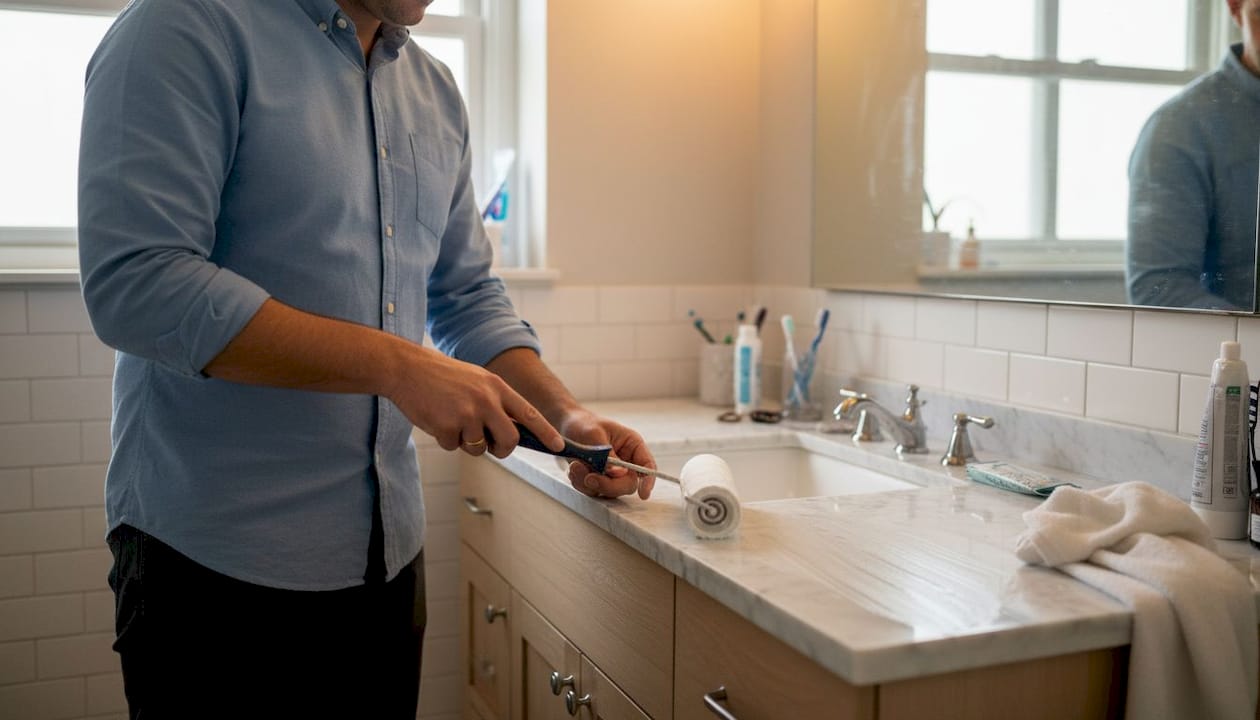
- Apply sealer in thin, even coats using a clean foam applicator, soft cloth, or low-nap roller. Work in small sections.
- Let the first coat absorb for the time specified on the product label, usually 5 to 15 minutes.
- Wipe away any excess sealer before it dries on the surface. Leftover sealer dries into a hazy film that is difficult to remove.
- Allow the coat to dry fully, then assess whether a second coat is needed using the water drop test.
- Buff lightly with a dry microfiber cloth once the final coat is set.
- Allow a full cure period of 24 to 48 hours before heavy use, and avoid wet mopping during this window.
Not all marble needs the same number of coats. Honed marble, which has a matte finish, is more porous than polished marble and typically requires two or even three coats. Polished marble with a mirror-like finish is denser and may only need one coat. Very porous varieties like Crema Marfil may need coats applied annually. If you’re sealing before grouting a new installation, apply the sealer first to protect the stone from grout haze.
| Marble finish | Coats needed | Cure time | Re-seal frequency |
|---|---|---|---|
| Polished | 1 coat | 24 hours | Every 1-3 years |
| Honed | 2-3 coats | 48 hours | Every 6-12 months |
| Very porous (Crema Marfil, etc.) | 2-3 coats | 48 hours | Every 6 months |
For more guidance on restoring marble floors before sealing, or if you manage a commercial property and need commercial stone care tips, those resources will help you plan the full scope of your project.
The truth about sealing marble: What most guides don’t tell you
Here’s what years of working with marble in South Florida have taught us: sealing is not a magic shield. It buys you time, but it doesn’t make your marble bulletproof.
The biggest misconception we encounter is that homeowners seal their marble and then feel free to leave spills sitting for hours. Sealing slows stain absorption but does not stop acid etching. A glass of orange juice or a splash of wine left on sealed marble will still etch the surface. The sealer just gives you a few extra minutes to wipe it up.
Another thing most guides skip: re-sealing schedules printed on product labels are marketing estimates, not scientific recommendations. Your marble’s actual condition, traffic level, and cleaning habits all affect how fast the sealer breaks down. Test annually with the water drop method and reseal based on what the stone tells you, not what the calendar says.
We also see homeowners invest in premium sealers but continue using acidic cleaners that strip the protection within weeks. A good sealer is your insurance policy, not a replacement for careful daily habits. The sealing marble value comes from pairing it with consistent, gentle maintenance.
Protect and restore your marble with expert help
If you want assurance your marble is sealed and protected to professional standards, South Florida’s experts are ready to help. At Affordable Marble Restoration, we assess each surface individually before recommending a sealing approach, because Carrara in a beachfront bathroom needs a different solution than Emperador on a commercial lobby floor.
Our team handles everything from surface assessment and deep cleaning to professional-grade sealing as part of our full marble restoration services. Whether you need a single countertop sealed or a complete floor restored across a multi-unit property, our expert stone restoration services are tailored to your stone’s specific condition. Contact us for a consultation and get a clear plan without the guesswork.
Frequently asked questions
How do I know if my marble needs to be resealed?
Drip water on a clean, dry section of your marble. If the surface darkens or the water soaks in within a few minutes, the sealer has worn down and it’s time to reseal. Absorption rates vary by marble type, so this test gives you accurate, surface-specific feedback.
What’s the difference between sealing and polishing marble?
Sealing fills the stone’s invisible pores to block liquids and stains from penetrating, while polishing is a physical process that smooths the surface to create shine and clarity. Both serve different purposes and are often done together as part of a full restoration.
Can sealing marble prevent all stains and etching?
No. Sealing slows stain absorption but cannot stop acid-based liquids from etching the surface. Wiping up spills immediately is still essential, even on freshly sealed marble.
How often should marble floors be sealed in South Florida?
Rather than following a fixed schedule, test your floors annually with the water drop method. Sealing frequency depends on testing, not calendars, and high-traffic or humid areas may need attention more often than low-use spaces.
What’s the best type of sealer for kitchen marble countertops?
Choose a water-based, penetrating impregnating sealer with a food-safe NSF/ANSI 51 rating and resistance to oil, acid, and heat. These formulas protect against kitchen hazards without releasing harmful fumes during or after application.
Recommended
- 6 Expert Commercial Stone Care Tips for Facility Managers
- How to restore marble floors: guide for South Florida homes
- Stone polishing: boost beauty and durability by 70%
- Stone Floor Polishing Process for Lasting Shine
- Stone cleaning | Kent and South of England
- Concrete Waterproofing Process for Durable Protection
