

Beautiful marble floors and counters can quickly lose their shine when exposed to South Florida’s unpredictable weather and daily wear. The truth is that marble, despite its elegance, is surprisingly vulnerable to acid, pollutants, and moisture found in the local environment. Understanding the scientific process behind marble restoration helps homeowners and property managers protect their investment and avoid the costly mistake of trusting common myths or DIY fixes.
Table of Contents
- Defining Marble Restoration And Common Myths
- Types Of Marble Damage And Restoration Scopes
- Essential Steps In The Restoration Process
- Costs, Risks, And Benefits Of Restoration
- Choosing Between Restoration And Replacement
Key Takeaways
| Point | Details |
|---|---|
| Marble Restoration Is Essential | Professional restoration renews and preserves marble to ensure its aesthetic and structural integrity. |
| Professional Techniques Are Crucial | Restoration requires sophisticated methods like grinding, honing, polishing, and sealing, tailored to specific damage types. |
| Understand Restoration Costs and Benefits | Weighing initial costs against long-term value and maintenance savings can justify restoration over replacement. |
| Choose Restoration When Possible | When structural integrity is maintained, restoration is often the preferred option over replacement for preserving historical value and aesthetics. |
Defining Marble Restoration and Common Myths
Marble restoration involves professionally renewing and preserving natural stone surfaces to return them to their original aesthetic and structural condition. Unlike simple cleaning, this specialized process addresses complex damage and wear through scientific techniques tailored to each stone’s unique characteristics.
Marble, a metamorphic stone composed of calcite or dolomite, requires nuanced care due to its delicate crystalline structure. Marble characteristics reveal significant vulnerabilities that many homeowners misunderstand. Common misconceptions about marble include:
- Marble is completely indestructible
- All marble types deteriorate identically
- Basic household cleaners are safe for all marble surfaces
- Restoration is a simple, uniform process
Professional marble restoration actually involves sophisticated diagnostic procedures that assess:
- Stone composition
- Specific damage mechanisms
- Environmental exposure factors
- Historical context of the stone surface
Professional restoration isn’t just about appearance—it’s about scientifically preserving your stone’s structural integrity and historical value.
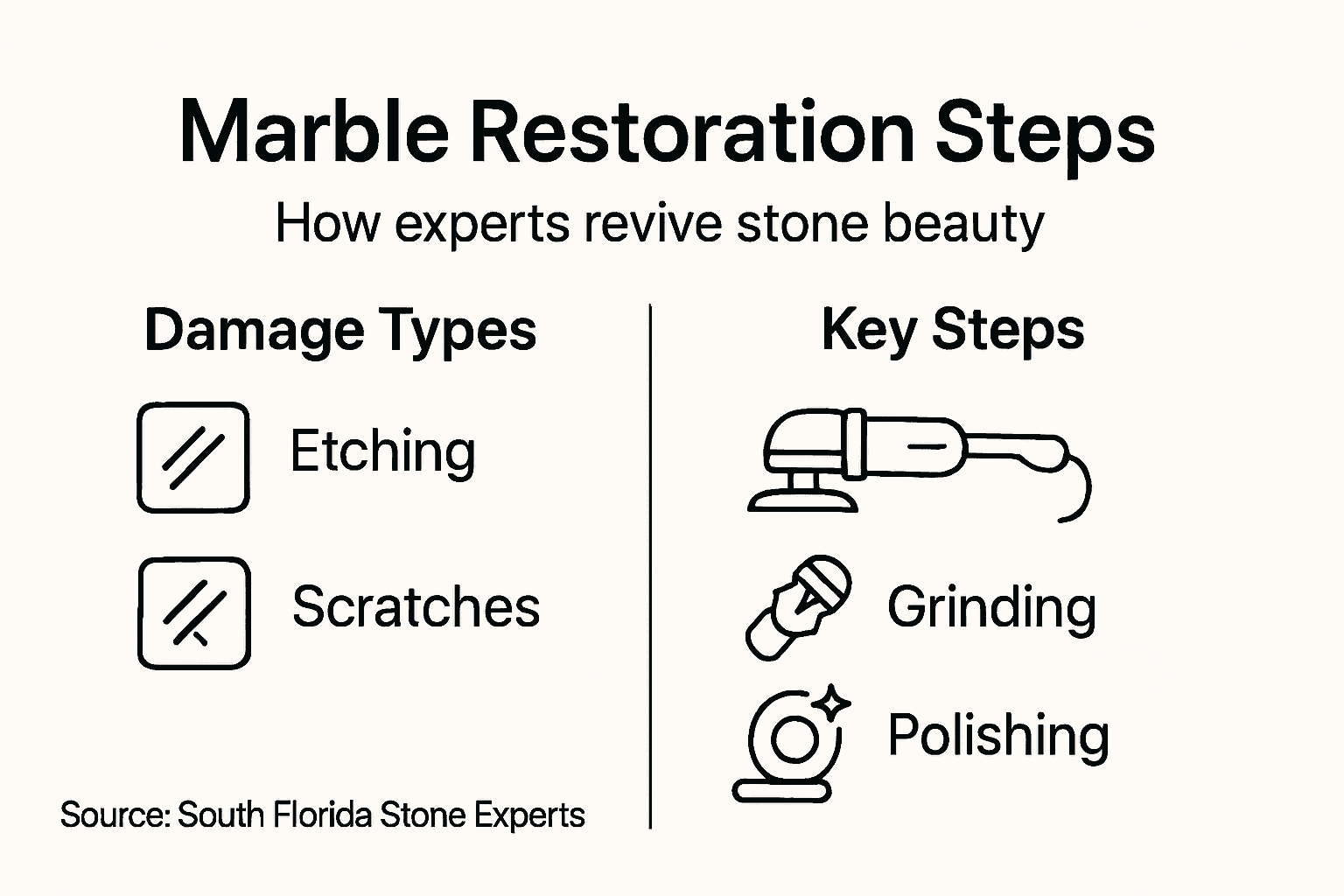
Restoration experts use specialized techniques like grinding, honing, polishing, and sealing to address different types of marble damage. These methods require deep understanding of stone properties, chemical interactions, and precise mechanical processes.
Here’s how popular marble restoration methods compare by their core applications and advantages:
| Method | Main Purpose | Typical Result |
|---|---|---|
| Grinding | Remove deep scratches | Smooth, flat surface |
| Honing | Eliminate minor marks | Satin, matte finish |
| Polishing | Enhance surface gloss | High shine, reflective look |
| Sealing | Protect from stains | Improved resistance to spills |
Pro Tip: Always consult a professional stone restoration specialist before attempting any DIY marble repair to prevent potentially irreversible damage.
Types of Marble Damage and Restoration Scopes
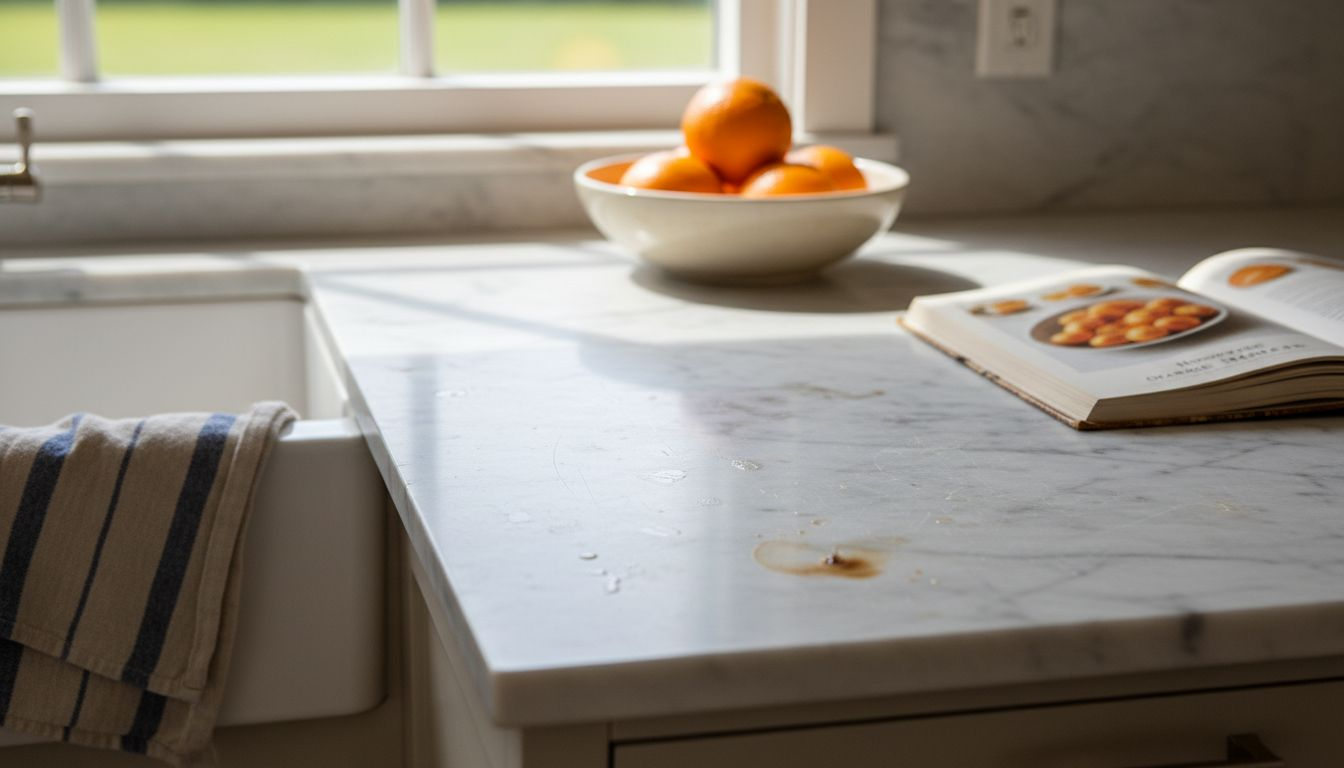
Marble surfaces in South Florida face numerous challenges that require professional restoration techniques. Acid precipitation causes significant marble deterioration, leading to complex damage mechanisms that demand specialized intervention.
The primary types of marble damage include:
- Chemical Erosion: Acid-based substances dissolving calcite
- Physical Abrasion: Surface scratching and mechanical wear
- Staining: Penetrative discoloration from organic and inorganic substances
- Environmental Degradation: Salt crystallization and weathering effects
- Biological Attack: Moss, algae, and microorganism growth
Restoration scopes vary dramatically depending on damage severity and stone characteristics. Professionals typically assess damage through comprehensive diagnostic procedures that evaluate:
- Material composition
- Extent of surface penetration
- Environmental exposure factors
- Structural integrity risks
Not all marble damage is visible—microscopic changes can signal significant underlying deterioration.
Advanced restoration techniques address these challenges through specialized methods like grinding, honing, polishing, and strategic sealing. Each approach targets specific damage types, requiring deep understanding of stone properties and precise mechanical interventions.
Pro Tip: Conduct annual marble surface inspections to catch potential damage early and prevent costly extensive restoration procedures.
Essential Steps in the Restoration Process
Marble restoration requires a systematic, scientifically-driven approach that transforms damaged stone surfaces through precise, carefully orchestrated steps. Restoration planning involves comprehensive multi-stage processes designed to address each unique marble surface’s specific challenges.
The essential steps in marble restoration include:
- Initial Assessment: Comprehensive damage evaluation
- Surface Documentation: Detailed photographic and written records
- Diagnostic Testing: Chemical and structural analysis
- Treatment Planning: Customized restoration strategy
- Surface Preparation: Cleaning and stabilization
- Restoration Execution: Targeted repair techniques
- Final Refinishing: Polishing and protective sealing
Professional restorers follow a rigorous sequence of interventions that typically encompass:
- Conduct thorough visual and technical surface inspection
- Perform microscopic damage analysis
- Select appropriate restoration techniques
- Execute precision restoration methods
- Apply protective treatments
- Implement ongoing maintenance recommendations
Successful marble restoration is a delicate balance between scientific understanding and skilled craftsmanship.
Each restoration stage requires specialized knowledge, advanced equipment, and a deep understanding of stone material properties. Technicians must carefully evaluate environmental factors, chemical interactions, and structural integrity to ensure comprehensive and lasting restoration.
Pro Tip: Request comprehensive documentation and before-and-after imagery to understand the full scope of your marble restoration project.
Costs, Risks, and Benefits of Restoration
Marble restoration represents a significant investment in preserving the aesthetic and structural integrity of natural stone surfaces. Economic valuation methods help balance restoration expenditures by carefully analyzing the potential long-term benefits against initial restoration costs.
The key financial considerations include:
- Initial Restoration Costs: Professional assessment and treatment expenses
- Material Replacement: Potential costs for irreparably damaged stone sections
- Long-Term Value Preservation: Increased property value and aesthetic appeal
- Maintenance Savings: Reduced future repair and replacement expenses
- Structural Integrity: Preventing more extensive damage
Potential risks associated with marble restoration range from:
- Inappropriate cleaning techniques
- Inexperienced restoration processes
- Potential further stone damage
- Unexpected additional repair costs
- Aesthetic inconsistencies
Professional restoration transforms a potential liability into a valuable asset.
Benefits of professional marble restoration extend beyond immediate visual improvements. Comprehensive restoration protects your investment by addressing underlying structural issues, preventing future deterioration, and maintaining the stone’s original beauty and value. Skilled technicians can often restore marble surfaces to near-original condition, avoiding costly full replacements.
Pro Tip: Request detailed cost breakdowns and comprehensive documentation to fully understand the potential return on your marble restoration investment.
Choosing Between Restoration and Replacement
Deciding between marble restoration and complete replacement requires careful evaluation of multiple critical factors. Conservation strategies balance preservation with practical needs by analyzing the extent of damage, historical significance, and long-term structural integrity.
Key considerations for choosing between restoration and replacement include:
- Damage Severity: Extent of marble surface deterioration
- Structural Integrity: Potential compromises in stone stability
- Historical Value: Significance of original material
- Cost Implications: Comparative expenses of restoration versus replacement
- Aesthetic Continuity: Maintaining original design and appearance
Professional assessment typically follows a structured decision-making process:
- Comprehensive surface damage evaluation
- Material structural integrity analysis
- Historical and aesthetic value assessment
- Cost-benefit analysis of restoration options
- Long-term durability projection
Not all damage requires complete replacement—skilled restoration can often revive seemingly beyond-repair marble surfaces.
Restoration becomes the preferred option when marble surfaces retain sufficient structural integrity, when historical authenticity is paramount, and when the cost of replacement significantly exceeds restoration expenses. Professional technicians can often recover and refinish marble surfaces that might initially appear irreparable.
Consider these decision factors when choosing between restoration and replacement:
| Factor | Restoration Advantage | When Replacement Makes Sense |
|---|---|---|
| Cost | Lower initial expense | When damage is beyond repair |
| Historical Value | Preserves original material | Irrelevant if no historic features |
| Aesthetic Continuity | Maintains design consistency | Needed for major redesigns |
| Structural Stability | Recovers surface strength | Required if stone is unsafe |
Pro Tip: Request a detailed diagnostic assessment from a qualified stone restoration specialist to determine the most cost-effective and preservation-friendly approach for your specific marble surface.
Restore and Protect Your South Florida Marble with Experts You Can Trust
Marble surfaces face complex challenges like chemical erosion, physical abrasion, and environmental degradation that require skilled, scientifically informed restoration. If you want to preserve your stone’s natural beauty and structural integrity, avoiding costly replacements is key. At Affordable Marble Restoration, based in Boca Raton, we specialize in customized marble restoration solutions including grinding, honing, polishing, and sealing tailored to your stone’s unique condition.
Don’t settle for surface-level fixes when your marble deserves comprehensive care. Our professional team understands the detailed diagnostic and treatment steps essential for lasting results. Act now to protect your valuable investment from irreversible damage by scheduling a consultation today. Learn more about our expert services and how we revive South Florida stone surfaces at Affordable Marble Restoration. You can also explore how we address specific marble repair and polishing needs to bring your stone back to life.
Take the first step toward restoring your marble’s elegance and durability. Contact us for a detailed evaluation and experience the difference professional restoration makes.
Frequently Asked Questions
What is marble restoration?
Marble restoration is the process of professionally renewing and preserving natural stone surfaces to restore their original aesthetic and structural condition. It involves specialized techniques to address complex damage rather than just cleaning.
What are the common types of marble damage?
Common types of marble damage include chemical erosion from acid-based substances, physical abrasion from scratching and wear, staining from penetrating substances, environmental degradation due to weathering, and biological attacks from moss and microorganisms.
How can I identify if my marble needs restoration?
Signs that your marble may need restoration include visible scratches, dull or uneven surfaces, stains that do not come out with regular cleaning, and signs of environmental wear or biological growth. Annual inspections can help catch potential damage early.
What are the benefits of professional marble restoration?
The benefits of professional marble restoration include preserving the stone’s structural integrity, enhancing its aesthetic appeal, preventing future deterioration, maintaining property value, and often restoring the marble to near-original condition while avoiding costly replacements.
