

TL;DR:
- Humidity and salt air in South Florida accelerate damage to hotel stone surfaces.
- Proper maintenance and timely restoration extend stone lifespan and reduce costs significantly.
- Choosing the right stone type and partnering with experienced specialists ensures lasting hotel aesthetics.
South Florida’s humidity doesn’t just curl your hair — it quietly attacks the natural stone surfaces your guests walk on, touch, and judge every single day. Marble lobbies can dull within months, travertine pool surrounds can develop mold, and limestone bathroom floors can etch before you even notice the damage. Preventive maintenance in coastal Florida hotels reduces the frequency and expense of major stone restoration, yet most managers only act after a guest complaint. This guide covers the stone types most common in South Florida hotels, the full restoration process, practical maintenance routines, and how to choose the right specialist.
Table of Contents
- Understanding natural stone in hotels
- The stone restoration process explained
- Preventive maintenance for South Florida hotels
- Choosing a restoration partner and modern alternatives
- The truth most hotels miss about stone restoration
- Partner with experts for lasting results
- Frequently asked questions
Key Takeaways
| Point | Details |
|---|---|
| Material selection matters | Choosing the right stone impacts maintenance costs and guest perception for years to come. |
| Humidity drives restoration needs | South Florida’s climate means sealing and moisture control are non-negotiable for hotel stone longevity. |
| Proactive care saves money | Regular maintenance dramatically extends the time between costly full-scale restorations. |
| Modern alternatives exist | Materials like quartzite offer marble-like beauty with less upkeep and longer wear. |
| Specialists add value | Partnering with experienced pros ensures proper restoration and helps hotels avoid common pitfalls. |
Understanding natural stone in hotels
Not all stone is equal, and knowing what you’re working with changes every decision downstream — from your cleaning routine to your restoration budget.
South Florida hotels most commonly feature marble, granite, terrazzo, and limestone. Each has its own personality. Marble is elegant and porous, which means it stains and etches from acidic spills like citrus juice or wine. Granite is denser and more forgiving, making it a smart pick for busy restaurant and bar countertops. Terrazzo, which blends marble or granite chips into a cement or epoxy base, is durable and increasingly popular in lobby floors for its design flexibility. Limestone is softer and more vulnerable to coastal salt air, so it requires more careful maintenance in beachfront properties.
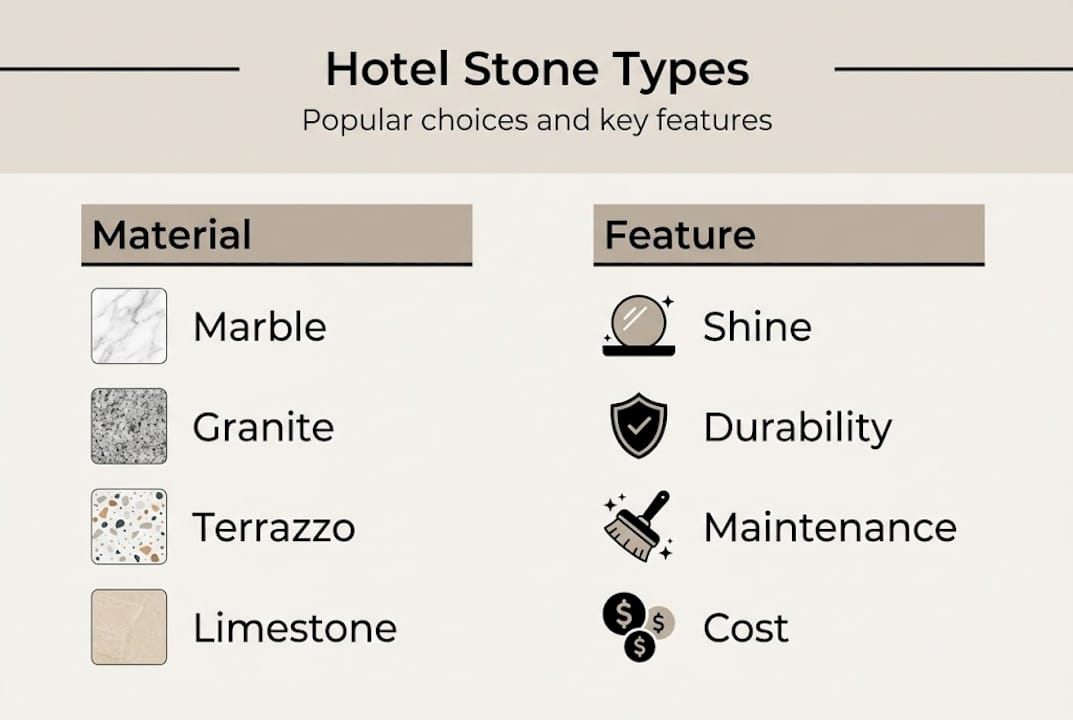
Engineered options like cultured marble and quartzite are also common in hotel bathrooms and common areas. Natural stone restoration revives original surfaces, while cultured marble is less authentic but lower maintenance. That’s worth knowing because the restoration process for each differs significantly. Natural stone can be ground, honed, and polished repeatedly over decades. Cultured marble has a thin gel coat that, once worn through, is very difficult to restore.
For long-term stone care, you need to understand porosity. The more porous a stone, the more it absorbs moisture, cleaning chemicals, and organic material. This is why a marble floor in a beachside hotel bathroom is a very different challenge than the same marble in a climate-controlled boardroom.
Here’s a quick breakdown of the most common hotel stone types:
- Marble: High visual impact, high porosity, needs frequent sealing and careful cleaning
- Granite: Dense, scratch-resistant, excellent for countertops and wet areas
- Terrazzo: Extremely durable, low porosity, ideal for lobbies and high-traffic corridors
- Limestone: Soft and warm-looking, but vulnerable to acids and salt air
- Cultured marble: Low porosity, consistent finish, but limited restoration options
| Feature | Natural stone | Cultured marble | Quartzite |
|---|---|---|---|
| Authenticity | High | Low | Medium-high |
| Porosity | High | Very low | Low |
| Restoration potential | Excellent | Limited | Good |
| Maintenance demand | High | Low | Low-medium |
| Best application | Lobbies, feature walls | Bathrooms, vanities | High-traffic countertops |
When considering hotel stone alternatives, design intent matters as much as budget. A luxury property’s brand identity may depend on the authenticity of natural marble. A boutique hotel might get equal visual impact from quartzite at a lower maintenance cost.
Key insight: The stone you choose today determines your restoration costs for the next 20 years. Make that decision with both aesthetics and South Florida’s climate in mind.
The stone restoration process explained
Restoration is not a single task. It’s a sequence of steps, each one building on the last. Skipping a step — or rushing it — can mean you’re back to square one within a year.
Restoring natural stone involves assessing wear, deep cleaning, grinding and polishing, and resealing to protect against future damage. Here’s how that looks in practice for a hotel environment:
- Inspection and assessment: A specialist examines the stone type, level of wear, presence of cracks or chips, and staining patterns. This step determines whether the stone needs light honing or full grinding.
- Deep cleaning: All surface soils, waxes, and prior sealers are removed. This is critical — polishing over old wax traps contaminants and shortens the result’s lifespan.
- Grinding: For heavily worn or deeply scratched stone, diamond-abrasive grinding removes the damaged top layer and levels uneven areas.
- Honing: This creates a smooth, matte or satin finish and removes light scratches and etching. Some properties prefer a honed finish because it hides wear better than a high-gloss polish.
- Polishing: Using progressively finer abrasives, polishing restores the mirror-like shine most guests associate with luxury hotel stone.
- Sealing: A quality penetrating sealer is applied to protect against moisture and staining. This step is what makes the restoration last.
Timeline and cost depend on stone type, total area, and traffic patterns. A bathroom floor might take half a day. A grand lobby could require a phased approach over several nights to avoid disrupting guests.
| Area size | Stone type | Estimated timeframe |
|---|---|---|
| Under 200 sq ft | Marble, travertine | 4-8 hours |
| 200-500 sq ft | Granite, terrazzo | 1-2 days |
| 500-1,500 sq ft | Mixed stone lobby | 2-5 days (phased) |
| 1,500+ sq ft | Terrazzo corridor | 5-10 days (phased) |
For a detailed look at what the marble floor repair process involves, the specifics differ from granite or terrazzo. Marble is softer and scratches more easily, so grinding must be done at lower speeds with finer abrasives. Terrazzo is more forgiving but requires special care at the grout lines between aggregate sections.
Pro Tip: Schedule full restoration during low-occupancy periods, like the early summer shoulder season in South Florida, when business travel slows. This minimizes guest disruption and gives the sealer adequate cure time before heavy foot traffic resumes.
Choosing a qualified specialist for this maintenance and restoration guide process matters enormously. An untrained technician using the wrong abrasive grit or wrong sealer chemistry can cause irreversible damage. That mistake often costs more to fix than the original restoration would have.
Preventive maintenance for South Florida hotels
Restoration works best when it’s paired with proactive care. Let’s look at how you can keep surfaces guest-ready and costs predictable.
South Florida’s average relative humidity regularly exceeds 60%, and coastal areas face the added challenge of salt-laden air that penetrates porous stone and accelerates surface breakdown. Preventive maintenance, especially humidity monitoring and regular sealing, significantly reduces expensive restorations for hotel stone in coastal Florida.
Here’s a structured maintenance schedule your team can actually follow:
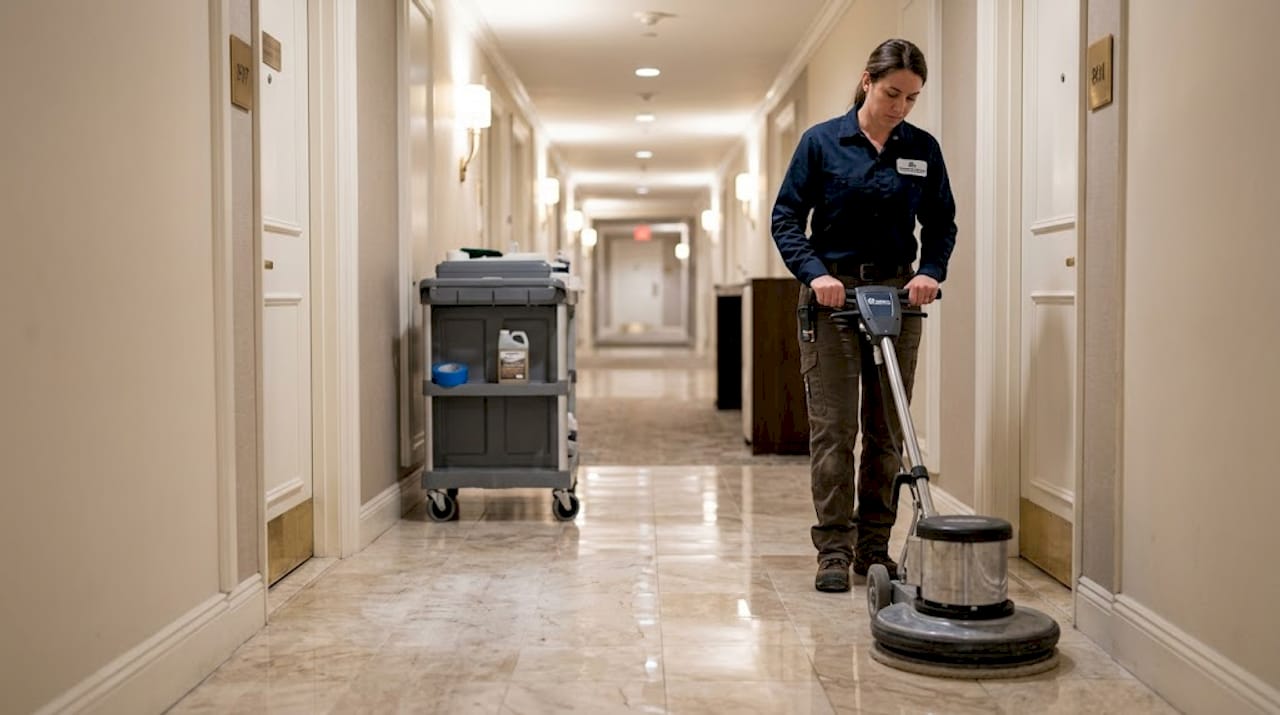
- Daily: Dust mop all stone floors with a microfiber pad. Clean spills immediately with a pH-neutral stone cleaner. Never use vinegar, bleach, or general-purpose sprays on stone.
- Weekly: Damp mop with a diluted stone-safe cleaner. Inspect high-traffic areas for new scratches, etch marks, or grout discoloration.
- Monthly: Check grout lines for cracking or staining. Inspect sealed surfaces by dripping water on them — if it soaks in rather than beads, resealing is due.
- Quarterly: Schedule a professional inspection in humid zones like bathrooms, pool surrounds, and outdoor patios. Review the HVAC humidity settings to keep indoor levels below 55%.
Proper marble maintenance in humid climates is about consistent, small actions rather than dramatic interventions. The hotels that avoid expensive emergency restorations are the ones that treat stone care as a routine line item, not a crisis response.
Pro Tip: Invest in a simple digital hygrometer for each major stone-floored area of your hotel. When readings regularly exceed 60%, it’s a signal to check your HVAC performance and inspect stone surfaces for early signs of mold or etching.
Understanding the importance of sealing marble cannot be overstated in this climate. A properly sealed surface repels moisture, resists staining from spills, and slows the etching caused by acidic cleaning products. In South Florida, resealing every 12 to 18 months is not excessive — it’s necessary.
Skipping these steps has real costs. A single season of deferred maintenance in a humid Florida hotel can turn a surface that needed a light polish into one requiring full grinding and resurfacing — a job that can cost five to ten times more. Your marble maintenance tips resource can help build a property-specific checklist your housekeeping team can execute without specialist oversight.
Choosing a restoration partner and modern alternatives
Strong maintenance helps, but getting expert help — and knowing when to consider new surfaces — is just as critical for long-term hotel value.
Not every company that calls itself a stone restoration specialist has the equipment, training, and product knowledge to work on the high-value surfaces in a hotel. Before signing any contract, ask these five questions:
- Do you have experience with hotel-scale projects and the scheduling constraints that come with them?
- Can you provide references from commercial properties in South Florida, particularly in coastal or high-humidity environments?
- What specific techniques and sealers do you use, and why are they appropriate for my stone type?
- How do you handle unexpected damage or color inconsistencies discovered during the job?
- What does your post-service guarantee actually cover, and for how long?
Red flags include vague guarantees with no documented terms, refusal to provide local references, and technicians who quote without actually inspecting the stone in person.
Knowing when to restore versus replace is equally important. Quartzite is a durable alternative to marble, offering a similar aesthetic with superior resistance to wear in hotel environments. For high-traffic bathroom countertops or pool-adjacent surfaces, replacing worn marble with quartzite may be a smarter 20-year investment than repeated restoration cycles.
| Factor | Restore existing stone | Replace with new material |
|---|---|---|
| Upfront cost | Lower | Higher |
| Long-term maintenance | Depends on stone type | Lower with quartzite/engineered |
| Aesthetic authenticity | Preserved | Varies by material |
| Disruption to operations | Moderate | High |
| Best scenario | Surface is structurally sound | Stone is cracked, deeply pitted |
For commercial stone care tips that go beyond the basics, working with a specialist who offers both restoration and material consultation gives you a more balanced recommendation. A company that only restores will almost always recommend restoration. A partner who understands the full picture can help you decide what actually serves your property best.
Design partners can also play a role here. Firms specializing in specialized stone solutions can guide material selection during renovation projects to ensure new installs are better suited for South Florida conditions from day one. This kind of upstream thinking is where the biggest savings often come from.
Worth noting: A restoration company that refuses to recommend replacement when replacement is the better option is not a partner — it’s a vendor. The right specialist will tell you the truth, even if it means less immediate work for them.
For properties managing multiple stone types across large areas, reviewing a broader commercial restoration maintenance resource can clarify how to prioritize which surfaces need attention first.
The truth most hotels miss about stone restoration
After years of working on hotel stone across South Florida, one pattern stands out above all others: the most expensive restoration jobs we see are not the result of bad stone or bad luck. They’re the result of deferred decisions.
Managers wait until a guest photographs a cracked lobby floor and posts it online. They wait until mold appears visibly on a travertine pool deck. By that point, what could have been a polishing job becomes a full grind and resurface — and sometimes a full material replacement.
Leading hotels treat stone the same way they treat HVAC systems: with annual audits, specialist relationships, and a maintenance budget that reflects reality. This long-term care approach is not just about cost control. It’s a brand statement. Guests in luxury properties notice everything — the shine on the lobby floor, the grout lines in the bathroom, the consistency of finish on the pool deck. Stone that’s actively maintained signals that your property pays attention to the details.
Modern materials like quartzite are not a compromise. In the right application, they’re the smarter choice. The hotels winning on long-term value are the ones making strategic material decisions alongside proactive care, not treating restoration as the only tool in the box.
Partner with experts for lasting results
Ready to protect your hotel’s stone investment? Affordable Marble Restoration brings deep experience in South Florida’s coastal conditions to every project, from grand lobby marble to travertine pool surrounds and granite bar tops. We understand the humidity, the salt air, and the scheduling demands of a working hotel. Our team offers free consultations and customized restoration plans tailored to your specific stone types and operational needs. Whether you need granite restoration services, concrete restoration solutions, or expert terrazzo restoration, we’re ready to help. Contact us to schedule your complimentary on-site assessment.
Frequently asked questions
How often should hotel stone surfaces be professionally restored?
Most hotel stone surfaces in humid regions like South Florida need professional restoration every 1 to 3 years, but proactive maintenance cuts full restoration frequency significantly and can extend that interval.
What’s the difference between natural and cultured stone for hotels?
Natural stone offers authentic beauty but requires sealing and careful maintenance, while cultured marble is less porous and easier to maintain but lacks the authentic look and restoration potential of true stone.
Why is sealing stone floors important for South Florida hotels?
Sealing creates a barrier against moisture and staining — especially critical in South Florida’s humidity — and regular sealing significantly reduces the need for costly full restorations in high-traffic hotel environments.
Are there alternatives to marble that offer similar looks but better durability?
Yes. Quartzite offers marble-like aesthetics with greater resistance to staining and etching, making it an excellent choice for hotel countertops, bathrooms, and other high-use areas.
What maintenance steps can hotel staff do daily to protect stone surfaces?
Daily dust mopping with microfiber pads, immediate spill clean-up using pH-neutral cleaners, and avoiding acidic products are the three most impactful daily habits for preserving stone between professional services.
